Rooftop solar power: From great potential to breakthrough development goals
With its vision of becoming a modern industrial center of the Northern midland and mountainous region, Thai Nguyen is accelerating its shift toward a green growth model, in which the development of rooftop solar power has been identified as a key task. Beyond helping ensure energy security and ease pressure on the power grid, the effective use of this clean energy source meets the increasingly high requirements for emissions reduction, enhances competitiveness, and lays the foundation for sustainable development in the new period.
TNG Investment and Trading Joint Stock Company operating a rooftop solar power system that meets about 9% of its electricity demand for production
From initial results to the need for a breakthrough
In recent years, in line with the Government's renewable energy development policy, rooftop solar power has gradually attracted investment interest from businesses and residents across the province. Harnessing this clean energy source not only helps cut electricity costs and reduce greenhouse gas emissions but also enhances energy self-sufficiency right at production facilities and households.
As of June 30, 2026, the total capacity of rooftop solar power combined with battery energy storage systems (BESS) across the province reached about 73.46 MW. Of this, industrial parks and industrial clusters accounted for 20.56 MW; businesses outside industrial parks accounted for 18.67 MW; households accounted for 34.23 MW; and public agencies accounted for only 25 kW. These figures show that the household sector currently accounts for the largest share of rooftop solar power development. With 34.23 MW, the residential sector accounts for about 46.6% of the province's total capacity. This reflects growing public awareness of the benefits of solar power, as well as the initial widespread acceptance of the self-generation, self-consumption model. Meanwhile, the business sector is becoming an important growth driver. With a total capacity of 39.23 MW, equivalent to 53.4% of the province's total capacity, this reflects a growing trend among businesses to proactively invest in green power sources to cut production costs, stabilize power supply, and, in particular, meet requirements on emissions reduction, renewable energy use, and sustainable development standards within global supply chains.
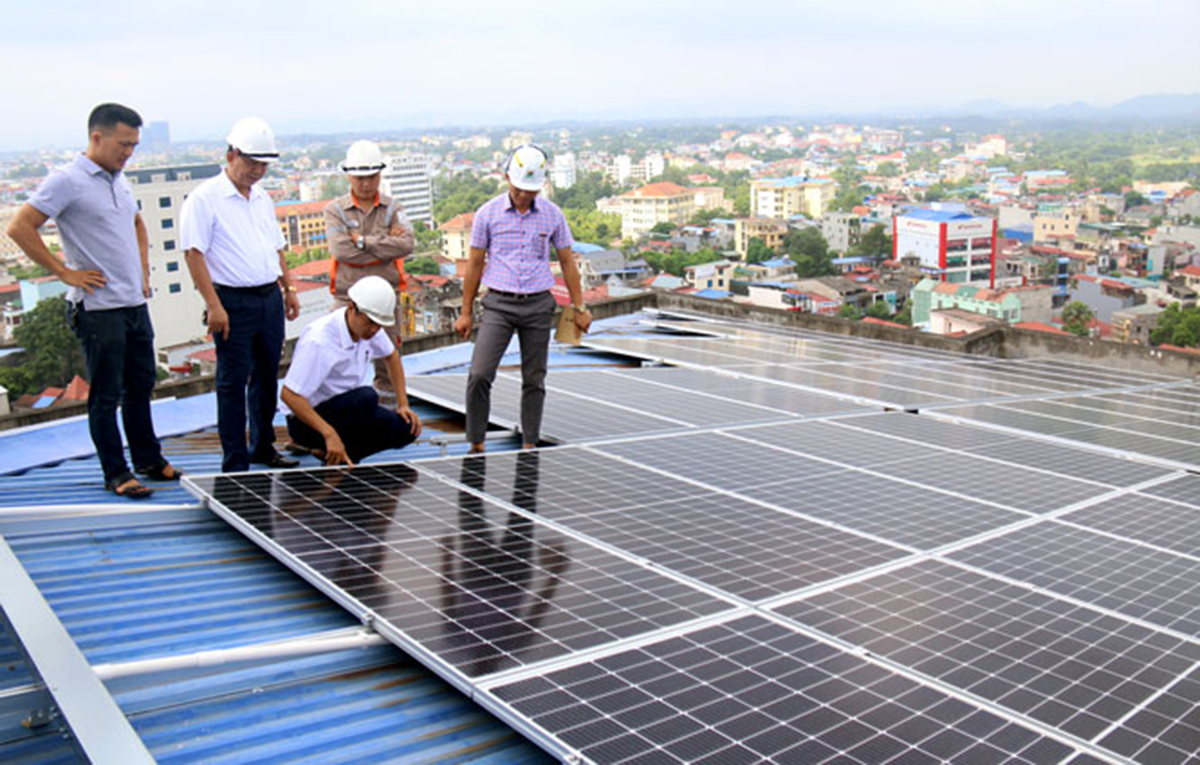
Thai Nguyen Solar Energy Company Limited (Solar Thai Nguyen) installing a rooftop solar power system
Representatives of a number of businesses investing in the province, such as TNG Investment and Trading Joint Stock Company, XCE Energy Joint Stock Company, Create Capital Vietnam Joint Stock Company, and Mani Hanoi Co., Ltd., are also rolling out rooftop solar power development to serve production. TNG Investment and Trading Joint Stock Company alone has already put into operation a solar power system that meets about 9% of its production electricity demand, demonstrating the clear effectiveness of this model.
However, when set against the scale of Thai Nguyen's industrial development, these results remain fairly modest. The main causes include high upfront investment costs; a power purchase mechanism that is not yet truly attractive; and grid connection and fire prevention and fighting regulations that still require detailed guidance for businesses. For the household sector, the absence of a subsidized electricity pricing mechanism, long payback periods, and a lack of policy information also make many residents hesitant to invest. This shows that, alongside the very strong demand from businesses and residents, the development of rooftop solar power urgently needs a coordinated legal framework, sufficiently strong incentive mechanisms, and the active support of state management agencies.
Unlocking the “rooftop resource”
As a locality with a rapid pace of industrialization and steadily growing electricity load demand, Thai Nguyen holds many advantages for developing rooftop solar power. Solar radiation intensity ranges from 3.8 - 4.5 kWh/m²/day, with an average of 1,400 - 1,690 sunshine hours per year - favorable conditions for effectively harnessing solar energy under the self-generation, self-consumption model. More importantly, under the adjusted Provincial Master Plan, Thai Nguyen has more than 18,000 hectares of industrial land. Hundreds of factories with very large roof areas are regarded as a special “resource” for developing distributed solar power. A further advantage is that businesses' electricity load is concentrated mainly during the daytime - which is also when solar power systems generate electricity most efficiently. This allows businesses to directly use most of the electricity they generate, significantly cutting power costs while improving investment efficiency.
Currently, many foreign-invested enterprises face considerable pressure from multinational corporations to use renewable energy, reduce greenhouse gas emissions, and meet environmental, social, and governance (ESG) standards. This is seen as a key driver making rooftop solar power an essential part of enterprises' development strategies.
According to preliminary calculations, the potential for rooftop solar power combined with BESS alone at the industrial parks and clusters already established in the province could reach about 1,623 MW by 2030, many times higher than current capacity. Beyond the industrial sector, administrative agencies, schools, and hospitals also have large roof areas, with a potential of about 6.5 MW. Meanwhile, the province has about 426,000 households, of which about 250,000 have suitable conditions for installing rooftop solar power. This represents very substantial room for expanding distributed power generation, helping ease pressure on the national grid.
The Trina Solar Energy Development Plant Project of Trina Solar Energy Development Company Limited (Trinor Energy Group - China) at Yen Binh Industrial Park
Potential only becomes meaningful once translated into concrete projects; therefore, Thai Nguyen is focusing on the coordinated implementation of numerous solutions to remove obstacles to rooftop solar power development. Based on the Party Central Committee's guidelines on ensuring energy security and developing self-generation, self-consumption rooftop solar power, the province will continue to improve its management mechanisms and provide specific guidance on investment, construction, grid connection, fire prevention and fighting, and environmental protection; study support mechanisms suitable for public agencies and households; and encourage access to preferential credit sources and the development of flexible investment models such as roof leasing, direct power purchase agreements, and public-private partnerships.
For industrial parks and industrial clusters, the province prioritizes allocating rooftop solar power development targets based on the actual needs of each business, giving priority to exporting businesses and those committed to reducing greenhouse gas emissions. The goal is not only to add more clean power sources but also to enhance businesses' competitiveness in the international market.
According to the Adjusted National Power Development Plan for the 2021 - 2030 period, with a vision to 2050, Thai Nguyen is planned to develop 1,070 MW of rooftop solar power by 2030. Affirming that rooftop solar power development is an inevitable trend and a new driver for green economic development, at the Conference on rolling out rooftop solar power development in the province, Chairman of the Provincial People's Committee Vuong Quoc Tuan requested that departments, agencies, localities, and the business community foster a spirit of initiative and partnership and coordinate closely to fulfill and exceed the planning targets, striving to develop about 1,000 MW at industrial parks and clusters and 150 MW outside industrial parks. This will help build Thai Nguyen step by step into a model locality for green energy development and efficient energy use, contributing to enhancing the competitiveness of the economy in the new period. The Chairman of the Provincial People's Committee emphasized that implementation of this task should be carried out on a voluntary basis but must be coordinated, driving strong change from awareness to action, with the goal of fulfilling and exceeding the set targets, thereby demonstrating the determination to translate the guidelines of the Party Central Committee and the Government, the Law on Electricity, and the regulations of the Ministry of Industry and Trade into practice.
With the resolute direction of provincial leaders, the close cooperation of departments, agencies, the power sector, and the business community, together with mechanisms that are being progressively improved, Thai Nguyen has a solid basis for realizing its rooftop solar power development goals, helping ensure energy security, drive green growth, and affirm its position as a modern industrial center in the country's energy transition process.