As culture increasingly affirms its role as an endogenous resource for development, many localities have chosen heritage as a foundation to establish a distinctive identity on the tourism map. For Thai Nguyen, a land rich in historical traditions and cultural identity, the values accumulated across generations are gradually being transformed into development resources. From historical sites and cultural spaces to large-scale arts programs held in rapid succession in recent times, all of these are contributing to opening new directions for the province’s tourism, cultural industries, and creative economy.
The richly creative, meticulously crafted stage of the “Thai Nguyen – Echoes of a Heritage Land” program
From the 2026 Intangible Cultural Heritage Performance Program themed “Thai Nguyen – Echoes of a Heritage Land” to the special arts program “Heritage Resonating Across the Ba Be Highlands,” Thai Nguyen province is gradually telling the story of its heritage land through a modern, captivating, and emotionally resonant artistic language. This is also how Thai Nguyen realizes the spirit of Resolution No. 80 in developing culture and people, and in making tourism a driving force for sustainable development in the new era.
When heritage steps beyond its preservation space
For many years, heritage conservation was associated with the thinking of “preserving the original state.” Heritage existed in inventory records, in museums, or in locally oriented traditional festivals. But in the current development context, that thinking has gradually shifted. To promote heritage values, heritage must be brought into contemporary life, and must connect with communities, visitors, and cultural markets. For this reason, Thai Nguyen’s organization of the 2026 Intangible Cultural Heritage Performance Program themed “Thai Nguyen – Echoes of a Heritage Land” is not merely an arts event; it is also a message of development. An artistic space has been opened as a journey from origins to modernity. The then melodies, the tinh lute, and the folk dances of ethnic minority communities are no longer present only in communal rituals but are being “staged” through a new performance language, integrating modern projection technology, sound, and lighting. In this way, heritage is brought closer to younger audiences and visitors. Ms. Hoang Thi Lanh of Ba Be commune shared: “In the past, many young people paid little attention to then singing or folk melodies. But when large-scale arts programs are organized, with beautiful stages and many visiting tourists, we feel our ethnic heritage is more valued. People are also prouder when their culture becomes a highlight that attracts tourists. I think this is a very good way to both preserve our cultural identity and help local people gain more opportunities for tourism and increase their income.”
Notably, Thai Nguyen has chosen not to pursue a merely “performative” approach but rather to create cultural experiences with depth. Each program item tells a story about the lives, beliefs, labor, and spirit of the communities of the Viet Bac ethnic groups. When art becomes a bridge, heritage will no longer be a “static memory” but a living current flowing through contemporary life.
The distinctive heritage space through the program item “Chau Dance in the Tay People’s Cap Sac Ceremony,” performed by People’s Artisan Nguyen Dang Luu and artisans in the “Thai Nguyen – Echoes of a Heritage Land” program
Art paving the way for heritage tourism
In current tourism development strategies, visitors are not only seeking scenic beauty but also want to experience local culture. A destination may be attractive for its natural scenery, but to retain visitors over the long term, what is essential is identity. Thai Nguyen is positioning its tourism in that direction. Whereas in the past, local tourism was typically associated with tea, ATK Dinh Hoa, or Nui Coc Lake, the province is now gradually expanding its tourism landscape to encompass cultural experiences and community heritage. The special arts program “Heritage Resonating Across the Ba Be Highlands” is a clear illustration of this orientation. Organized within the framework of the Opening of the Thai Nguyen Tourism Season 2026, the program is not only a performing arts event but also a richly creative “tourism communications product.”
Amid the magnificent natural setting of Ba Be Lake, an outdoor stage was designed to harmonize with the mountains, forests, water surface, and lighting, creating a remarkable visual experience for visitors. Nearly 200 artists, performers, artisans, and folk culture clubs participated in the performance, creating a multi-hued artistic tableau. Program items including then singing – tinh lute performance, H’mong khen dance, Dao ethnic dance, lyrical dance, and an immersive outdoor song and dance performance on the lake conveyed a sense that was both sacred and intimate. Notably, the program did not confine itself to traditional art forms but boldly integrated a contemporary dimension through the participation of rapper Double2T alongside young artists. This combination illustrates Thai Nguyen’s new approach: preserving cultural identity alongside creativity, so that heritage continues to resonate vibrantly, authentically, and accessibly in contemporary life.
From “cultural asset” to “development resource”
Resolution No. 80 of the Politburo has identified culture as an endogenous resource and driver of sustainable development. In this new development thinking, heritage is not merely to be preserved but must be “awakened” into economic value, brand value, and the soft power of the locality. Thai Nguyen is heading in the right direction by choosing culture as the foundation for tourism development. In practice, the province possesses a rich heritage treasury of many ethnic groups, including the Tay, Nung, Dao, H’mong, and San Chay, with a system of festivals, folk performing arts, traditional crafts, and indigenous knowledge rich in cultural identity. This is a special resource that not every locality can claim.
The large-scale arts programs held in recent times show that Thai Nguyen is shifting from an “event-organizing” mindset to a “cultural brand-building” mindset. Each program is designed not only to serve on-site audiences but also to achieve broad reach on digital platforms, social media, and tourism media. This is the appropriate direction in an era when the image of a destination is strongly shaped by visual media products and emotional experiences. Ms. Le Minh Anh, a visitor from Ho Chi Minh City, shared: “I think Thai Nguyen is pursuing a very distinctive approach to tourism development. Not only promoting scenic beauty, but also telling cultural stories through art. When watching the programs, I clearly perceive the identity of this land through music, costumes, rituals, and even the stage space itself. This is something many tourist destinations currently lack. Programs like these will certainly help Thai Nguyen’s image spread more widely on social media and attract young tourists.”
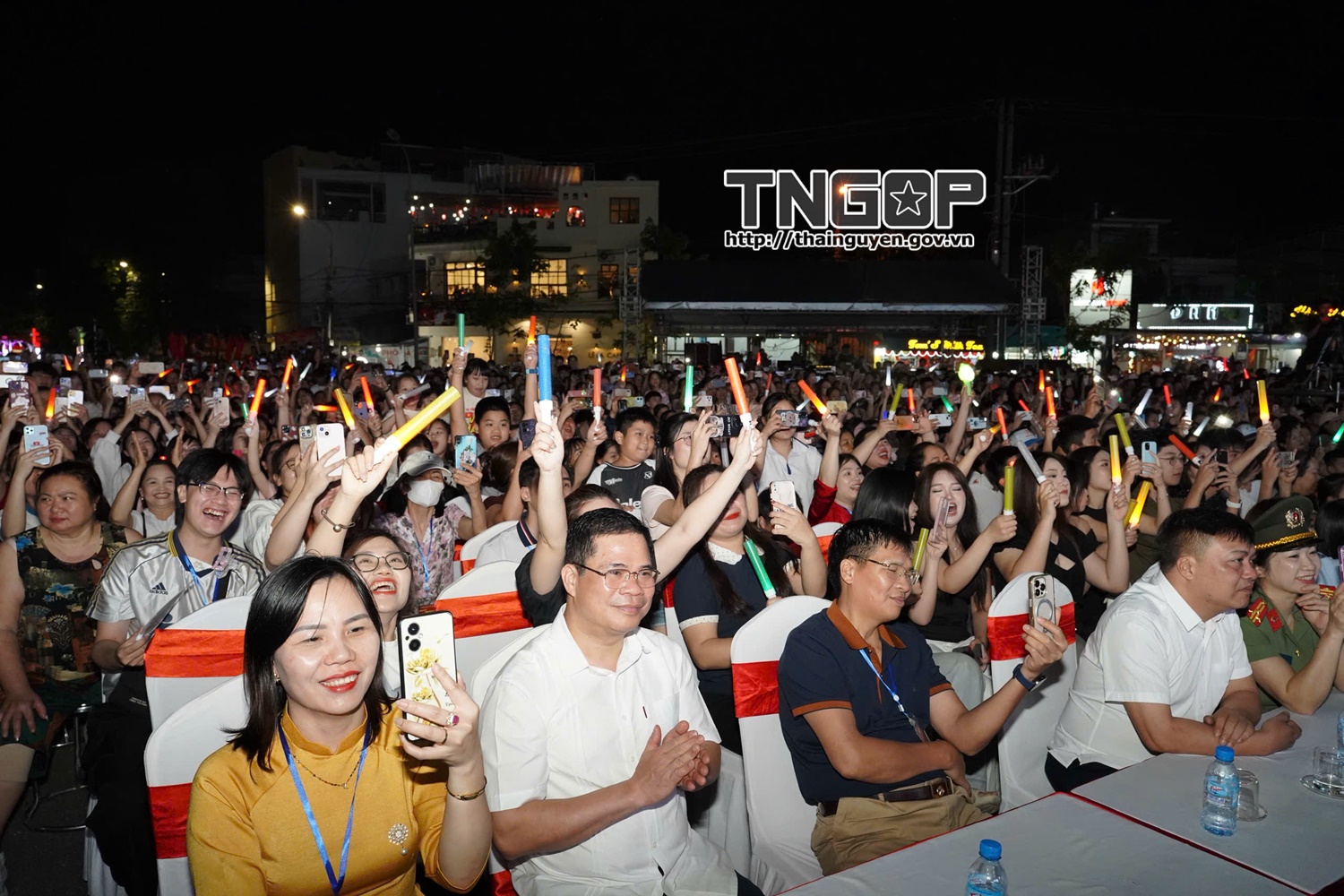
Large-scale arts programs promoting heritage have been followed with enthusiasm by large numbers of residents and visitors, with the expectation that they will soon become a tourism product of the province
Nevertheless, for heritage to truly become a driving force for development, much work remains to be done. Mr. Dang Van Kien, a visitor from Hai Phong, shared: “I have traveled to many localities, but I was very impressed by the large-scale arts programs promoting heritage and tourism in Thai Nguyen. However, in my view, these large-scale arts programs need to be organized in a professional, regular manner with a distinctive mark in order to build a characteristic cultural tourism brand for the locality. More importantly, after each program, it is necessary to continue developing community-based tourism products, cultural experience tours, and regular performance spaces to retain visitors.”
It can be seen that, through large-scale arts programs, Thai Nguyen is gradually affirming a new development vision: taking culture as the foundation, heritage as identity, and creativity as the driving force for sustainable tourism development. In that journey, heritage no longer rests quietly in the past. The then song melodies, the tinh lute, the dances amid the highlands, and the artistic spaces by Ba Be Lake today continue to resonate, connecting tradition with modernity, connecting community with visitors, and opening new development opportunities for the culturally rich Viet Bac land.