Thai Nguyen proactively cares for and promotes the role of the elderly amid population aging trend
Population aging is no longer a story of the future but is now clearly present in social life. As life expectancy continues to rise, the rapidly growing number of elderly people also means new requirements for healthcare, rehabilitation, long-term care, and social security. For Thai Nguyen, where the elderly currently account for nearly 16% of the population, adapting to population aging is not only a task for the health sector but also a sustainable development strategy for the entire political system.
Elderly people in Thai Nguyen Province actively taking part in the province's cultural and sports events (Photo: Elderly people taking part in the First Physical Training and Sports Congress 2026 of Quan Trieu Ward)
Proactively responding to the pace of population aging
In recent years, in line with the general trend of the whole country, the rate of population aging in Thai Nguyen Province has occurred quite rapidly. As of 2026, the province has over 272,000 elderly people, accounting for about 15.67% of the population. This figure reflects a reality: Thai Nguyen is entering a period of demographic structural transition, with new requirements for healthcare and ensuring quality of life for the elderly.
Whereas in the past, policies for the elderly mainly focused on subsidies and care in old age, the requirement now is to build an integrated, continuous care system, ranging from disease prevention, health management, and treatment of chronic diseases to rehabilitation and long-term care. Reality in Thai Nguyen shows that the elderly are not only a group in need of care but also an important resource for socio-economic development.
The province currently has 1,566 elderly people who are business owners or farm owners; 2,041 people have been recognized at various levels for excellence in economic activities. In addition to contributing to economic development, more than 12,500 elderly people are participating in building the grassroots political system, holding various positions such as Party cell secretaries, hamlet heads, residential group leaders, heads of Fatherland Front working boards, and leaders of mass organizations. Thousands of highly qualified professionals continue to take part in teaching, scientific research, medical examination and treatment, and literary and artistic creation. Tens of thousands of people actively participate in promoting education, building cultural life, maintaining security and order, and mediating disputes at the grassroots level. These figures show that the elderly are not only recipients of policy benefits but also an important force contributing to community development, in keeping with the spirit of "Advanced in Age - Shining Example”.
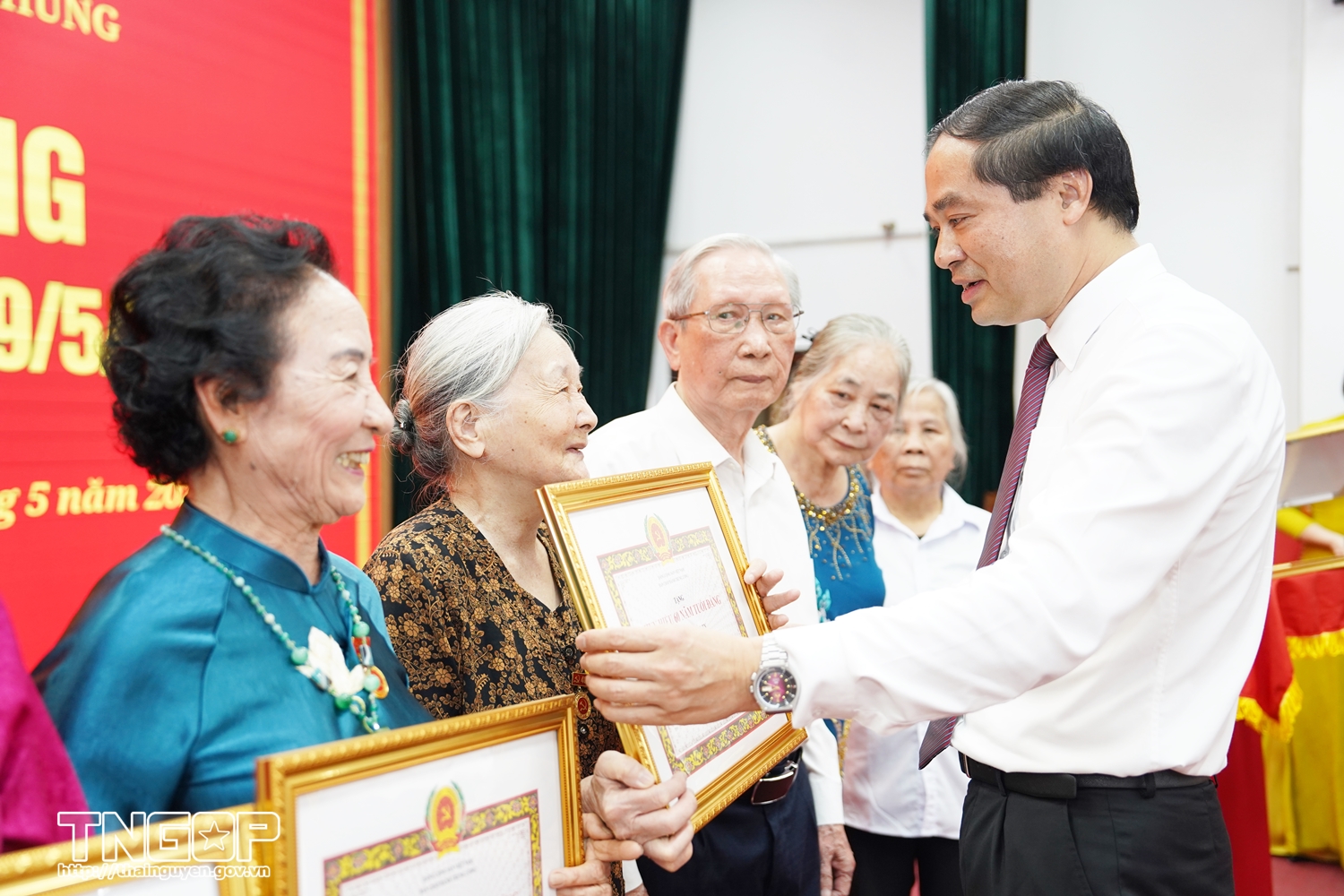
Comrade Trinh Xuan Truong, Member of the Party Central Executive Committee and Secretary of the Provincial Party Committee, presents 60-Year Party Membership Badges to Party members in Phan Dinh Phung Ward
Making a strong shift from treatment to comprehensive care
Along with the increasing number of elderly people, chronic diseases such as hypertension, diabetes, cardiovascular disease, musculoskeletal disorders, and dementia are becoming more common, requiring care to be provided regularly and continuously right at the community level. Determining that caring for the health of the elderly is a long-term task, Thai Nguyen has focused on investing in and strengthening the grassroots healthcare network, expanding health management for the entire population, and improving the quality of medical examination, treatment, and management of non-communicable diseases. To date, more than 160,000 elderly people in the province have received free health check-ups, reaching nearly 60% of the total elderly population. These are not only figures on coverage rates but also reflect a shift in healthcare thinking from "treating illness" to "managing health”, detecting disease risks early for timely treatment and limiting complications.
In parallel, social assistance policies continue to be implemented fully and to the right beneficiaries. More than 32,000 elderly people currently receive monthly social allowances, helping to ensure their livelihoods, especially for elderly people who are alone, without support, or facing particularly difficult circumstances. Alongside the involvement of the health sector, Associations for the Elderly at all levels in the province continue to promote their core role in caring for, protecting, and promoting the role of the elderly. Cultural, artistic, physical training and sports, health exercise, and intergenerational self-help club activities are being maintained, helping the elderly live happily, healthily, and usefully, while reducing the risk of illness and limiting loneliness in old age.
Elderly people of Cuong Loi Commune receiving medical examinations at the Community Health Care and Elderly Health Care Center
Building a care system adapted to an aging society
It is forecast that by 2035, our country will end its golden population structure period and officially enter the aging population stage. Thai Nguyen is no exception to this trend, as the proportion of people aged 60 and above continues to rise. This requires proactive, early, and far-sighted preparation, rather than waiting until the pressure of an aging population becomes too great before seeking solutions.
On June 10, 2026, the Provincial People's Committee issued Decision No. 1778/QD-UBND on implementing the National Strategy on the Elderly in the province. This is regarded as an important step toward building a comprehensive, modern, inclusive, and sustainable policy system for the elderly. Accordingly, the province aims to continuously improve the material and spiritual lives of the elderly, and enable the elderly to fully access basic social services, especially healthcare, rehabilitation, long-term care, and social assistance services. Among these, elderly people from poor and near-poor households, those facing difficult circumstances, and those living in areas of particular difficulty are given priority support. Notably, the strategy focuses not only on care but also on promoting the wisdom, experience, and role of the elderly in socio-economic development, while mobilizing the participation of the entire society in the elderly care system.
To realize this goal, the health sector has been identified as playing the core role. General hospitals in the province are gradually establishing Geriatrics Departments to meet the demand for specialized examination and treatment of the elderly. This is a necessary step given the increasingly diverse range of age-related conditions, which requires specialized professional teams and treatment methods. Along with this, the province encourages the mobilization of social resources to develop elderly health care centers, nursing homes, and professional care services.
One of the new aspects of Thai Nguyen's strategy for adapting to population aging is the development of a community-based elderly care model. Instead of relying entirely on hospitals or centralized nursing facilities, the elderly will be cared for right where they live, with coordination among families, grassroots healthcare, and social organizations. This model not only helps reduce the burden on the healthcare system but also enables the elderly to live in familiar surroundings close to their loved ones, thereby improving their quality of life.
Elderly people of Phong Quang Commune persistently preserving the craft of embroidering ethnic costumes
Amid population aging as an irreversible trend, early preparation of an integrated, elderly-centered care system will help Thai Nguyen proactively adapt to changes in population structure. More importantly, it is also a way for every elderly person not only to live longer but also to live healthier, happier, and continue contributing to the community.
Population aging is a challenge, but it is also a test of the quality of a locality's development. The steps Thai Nguyen is taking today are not only intended to meet immediate needs but also to lay the foundation for a humane society, where the elderly are cared for through policy, the healthcare system, and community support. When that happens, old age will no longer be a burden, but will become a period of peaceful, healthy living, continuing to spread precious values to families and society.