Finalizing the plan to conserve and promote the values of Ba Be Lake scenic landscape
Over two days (October 17 and 18), a working delegation from the Ministry of Culture, Sports and Tourism led by Deputy Minister Hoang Dao Cuong, alongside Comrade Trinh Xuan Truong, Member of the Party Central Executive Committee and Secretary of Thai Nguyen Provincial Party Committee, conducted a field survey at several sites within the Special National Relic Site - Ba Be Lake Scenic Landscape to serve the review and finalization of the planning scheme for the conservation, renovation, and restoration of the Relic Site.
Delegation holding a working session at Ba Be Commune People's Committee
Leaders of Thai Nguyen Province at the working session
Joining the survey program were Nguyen The Manh, Deputy Secretary of the Provincial Party Committee and Chairman of the Provincial People's Committee; Duong Van Luong, Vice Chairman of the Provincial People's Committee; representatives of the Department of Cultural Heritage, and leaders of relevant departments, sectors, and localities.
Delegation conducting a field survey along the Nang River
At survey sites along the Nang River, as well as at Puong Cave and An Ma Temple, the delegation focused on assessing the current state of landscapes, residential spaces, heritage values, and issues requiring in-depth study during the planning finalization process. The key focus was to clearly define the scope and protection requirements for each zone, ensuring harmony between preserving the values of the Relic Site and stabilizing the lives and livelihoods of local residents while advancing sustainable tourism development.
According to proposals by Thai Nguyen Provincial Project Management Board for Investment in Construction of Civil and Industrial Works, priority in Cam, Coc Toc, and Pac Ngoi villages should be given to renovating residential spaces, conserving traditional architecture, and gradually upgrading infrastructure in tandem with community-based tourism development. For areas along the Nang and Leng rivers, as well as the Coc Toc and Bo Lu streams, it is necessary to clearly define corridors for water source and landscape protection. In the areas of Puong Cave, Tien Pond, the area east of Pe Lam Lake, and An Ma Island, the fundamental direction is conservation, minimizing impacts on the natural landscape. Hua Ma Cave in particular is being studied for development into a visitor reception point, connecting with other heritage attractions across the Ba Be Lake scenic complex.
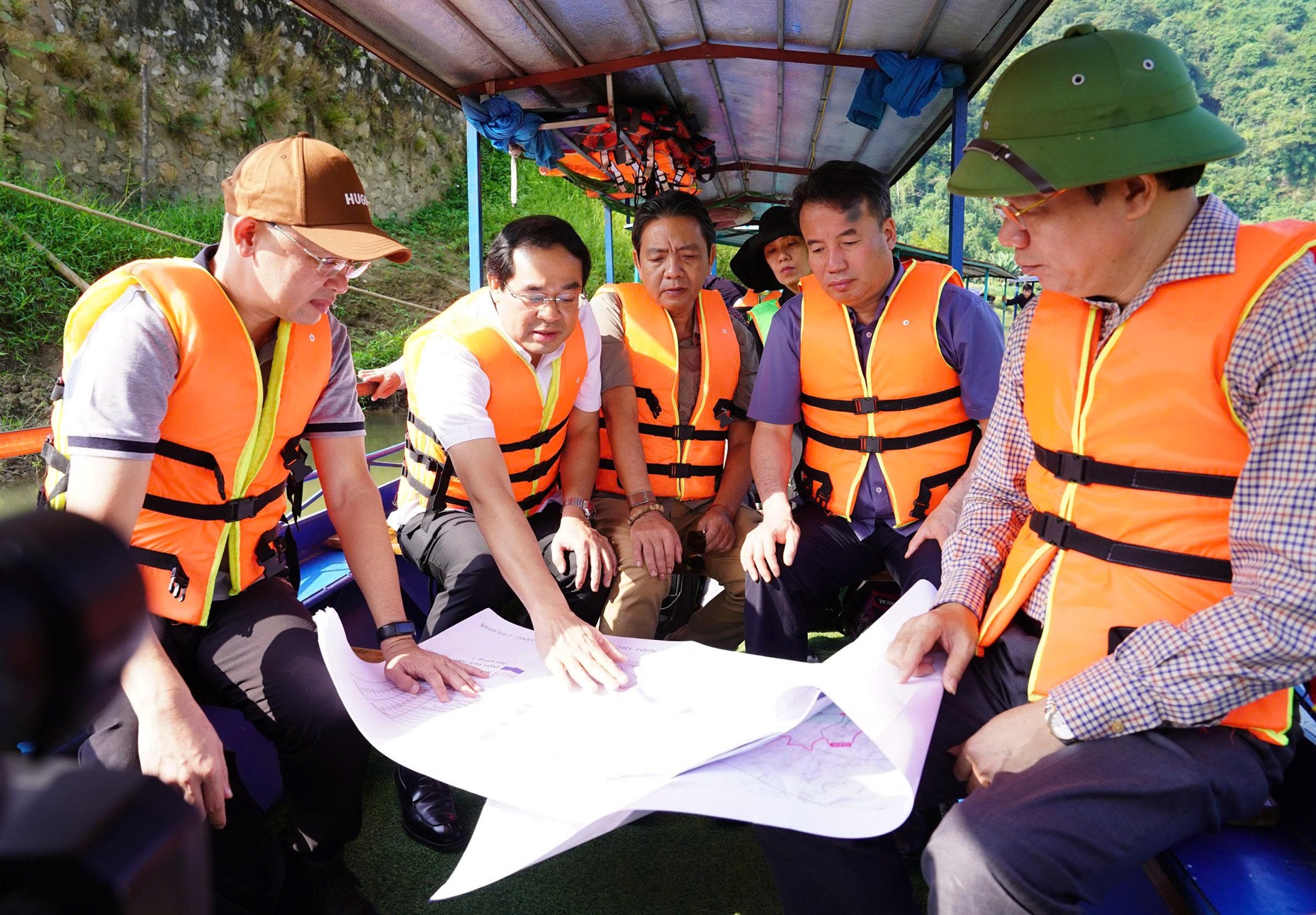
Leaders of the Ministry of Culture, Sports and Tourism and leaders of Thai Nguyen Province reviewing the planning scheme for the conservation, renovation, and restoration of the Special National Relic Site - Ba Be Lake Scenic Landscape
Through the survey, Deputy Minister of Culture, Sports and Tourism Hoang Dao Cuong and the delegation fundamentally concurred with the directions and proposals for finalizing the planning scheme. At the same time, they requested that the adjustment process be grounded in scientific and practical foundations, fully recognizing all heritage values; clearly delineating conservation zones, residential areas, and service areas; and thoroughly assessing impacts on landscapes, ecosystems, and indigenous culture. Tourism development must go hand in hand with preserving the authenticity of heritage, ensuring the close attachment of residential communities to the space of the Relic Site.
Leaders of the Ministry of Culture, Sports and Tourism and leaders of Thai Nguyen Province discussing the planning scheme
Speaking during the survey program, Secretary of the Provincial Party Committee Trinh Xuan Truong and Chairman of the Provincial People's Committee Nguyen The Manh emphasized that the overarching requirement in guiding the development of Ba Be Lake is conserving nature, preserving cultural identity, and improving people's livelihoods. The planning must position the lake as the central hub of connectivity, integrating landscape protection, biodiversity, and geological and cave values with infrastructure layout, architectural control, and the development of appropriate tourism products.
Alongside ecotourism, resort tourism, and nature exploration, the province guides the development of community-based tourism, indigenous cultural experiences, and agricultural tourism linked to OCOP products. Finalizing the planning also aims to establish a basis for addressing constraints in transportation, landscapes, and the environment; strengthening the connectivity of tours and routes; enhancing destination appeal; and generating additional jobs and income for local people.
Delegation conducting a field survey at Puong Cave
The Secretary of the Provincial Party Committee directed relevant departments, sectors, and localities to incorporate the feedback of the delegation, continue reviewing each subdivision, and clarify difficulties and bottlenecks to finalize the planning scheme. Special attention should be paid to ensuring residential stability, renovating villages, and safeguarding residents' legitimate rights and livelihoods, while cautiously evaluating the necessity of relocation and resettlement to avoid disrupting community life.
He emphasized that the planning must couple heritage preservation with sustainable tourism development, facilitating the attraction of capable investors, while encouraging local residents to participate in conservation, develop tourism services, and directly benefit from heritage values. This will help gradually leverage the potential and strengths of the Special National Relic Site - Ba Be Lake Scenic Landscape, working toward building this area into an attractive tourism destination deeply imbued with the identity of the northern midland and mountainous region.
Delegation conducting a field survey at Dau Dang Waterfall